
Our fertility factors explained
Getting pregnant and carrying a pregnancy to term are actually very complex processes. Many things can go wrong during this time and that is why we believe having a child is truly life’s greatest gift!
There are several different factors that can affect a couple when trying to conceive and possibly can result in having difficulty getting pregnant. Many couples experience either male factor or female factor from just one partner. This can make it more difficult to get pregnant, but pregnancy can still occur naturally or in some cases the couple may have to seek out fertility treatment. We unfortunately have factors from each side, both Dustin and myself. So, it feels like we have double working against us in our efforts to start our family. Once we discovered this, we knew it was almost a certainty that the only way we were going to be able to conceive was with the help of fertility treatment.
When Dustin and I first met, one of the reasons we connected immediately was because of all the things we had in common and all the similarities in our lives. So, to share this as well and both have fertility factors that affect our ability to start a family of our own is something we chose to view as just another reason we are meant for each other. As a couple, we are able to truly understand and empathize with how the other is feeling. Understanding exactly how your partner feels and being able to be there for each other on that level is the silver lining. Even though the difficulties with fertility can be so challenging, we have each other.
Danielle’s Fertility Factor
Danielle’s Fertility Factor: PCOS (Polycystic Ovarian Syndrome). Polycystic ovarian syndrome or “P-C-O-S”, is a condition in which female hormones are out of balance. Women with PCOS are affected by this imbalance with an array of health issues (which can include difficulty getting pregnant) and daily symptoms that vary on a case-by-case basis. Also, symptoms can fluctuate over time. To give examples of some symptoms – Women with PCOS may not ovulate. Women with PCOS are often insulin resistant; their bodies can make insulin but can’t use it effectively. They may produce an abnormal amount or high levels of androgens, may have problems with their metabolism, are more prone to inflammation, and can have many small cysts on the ovaries. “The symptoms of PCOS tend to run in families, the syndrome is probably caused, at least in part, by a change, or mutation, in one or more genes.” There is still so much that is unknown about PCOS.“Researchers and health care providers know that genetic and environmental factors contribute to the development of PCOS, but do not know exactly what causes PCOS. PCOS likely results from a combination of causes, including genes and environmental factors.[1] There is currently no cure for PCOS, but there are treatments to help minimize symptoms. Treatments for PCOS, its specific symptoms, and its associated health problems vary, but they may include lifestyle changes and medications.[2] ” Lifestyle changes that have been shown to help many are dietary, including a gluten free and dairy free diet.
I was diagnosed with PCOS at a relatively young age. It was at the start of my freshman year in college that I began to do my own research on the many symptoms I was experiencing and sought out medical treatment. In my early twenties and around this time, I did experience the absence or skipping of a menstruation cycle. However, over time that symptom has resolved, and I currently get a regular menstrual cycle each month. The most challenging thing for me has been managing symptoms with lifestyle changes over the years. PCOS is a very complicated condition so it can be unsettling at times to manage all the things PCOS can have an effect on daily. Or also for example, how one abnormal hormone level can have a trickle-down effect and impact many different aspects of how your body functions, including how you feel and your overall health. Having PCOS for my entire adult life, I always knew there was a possibility of it affecting my fertility and there was a chance I would have difficulty getting pregnant. It is the exact opposite and a much different scenario for Dustin.
Dustin’s Fertility Factor
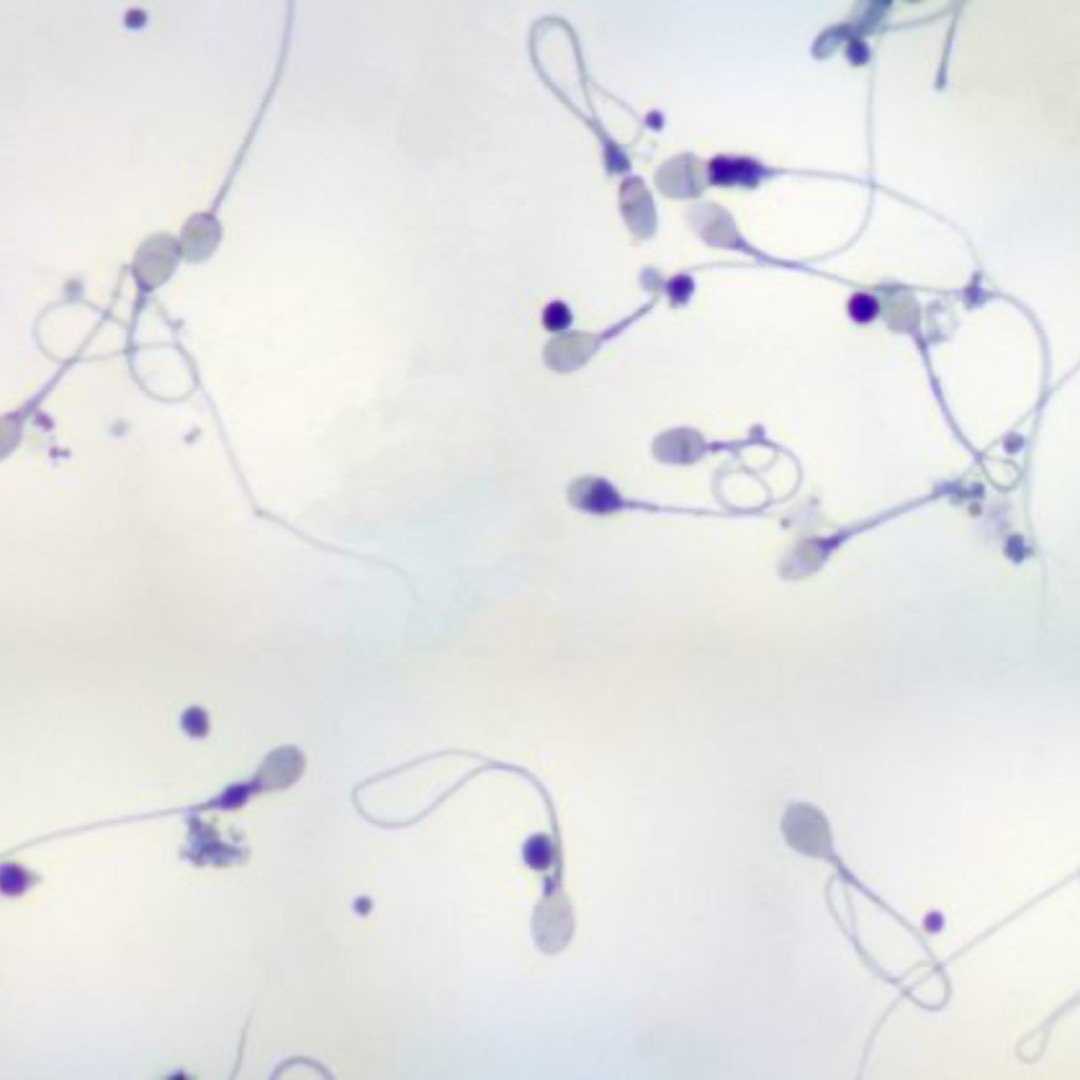
Dustin’s Fertility Factor: Morphology. Morphology refers to the size, shape and appearance of a man’s sperm, which when abnormal can decrease fertility and make it more difficult to fertilize the woman’s egg. Dustin’s male factor morphology specifically refers to the shape of his sperm and having a very low percentage of normal shaped sperm. Having an abnormal shape makes it difficult for the sperm to swim properly in order to reach the egg for fertilization.
When we originally went in for fertility testing, it was mainly because we knew I had PCOS as a preexisting condition. It was a surprise when we found out that Dustin also had a factor as well, because we had no prior knowledge. “Many different issues can affect the formation of sperm in the testicles. These conditions can lead to sperm that is abnormally shaped or malformed or to low amounts of sperm.[3]” (Dustin has a normal amount of sperm so he does not have a low sperm count, only the shape is affected.)
After discovering this, we obviously wanted to try to find out the “why” and what caused his fertility factor? We saw a urologist in addition to our fertility specialist for further exploration as to what may have caused this. However, after reviewing Dustin’s medical records in depth, his fertility testing results and going over everything we could possibly think of, the cause is undetermined. Meaning we don’t know why or what is the cause. Genetic traits, infection, chromosomal defects, hormones, chemical exposure, and even increased testicular temperature (which can be due to the natural position of one’s testicles in relation to the body) all can cause abnormal sperm – to name a few. So any one of these can affect morphology or a combination of. These and other causes can affect sperm in general (not specific to morphology) so there are many things to take into consideration. In terms of abnormal sperm morphology as a genetic trait – unless a parent or grandparent tests their semen sample, abnormal sperm morphology can go unnoticed from generation to generation. So, this can be tricky to identify. In general, the impact of genetics on male fertility is not fully understood. Most men with abnormal sperm morphology are still able to father a child, but achieving pregnancy may take longer or require assistance from a fertility specialist. However, when combined with female factor the chances of natural pregnancy become significantly less.
When doing research, reading, and getting information for both our factors, there is just so much that is still being studied. Fertility is incredibly complex and the number of factors and combinations that can have an impact on it seems infinite. Not to mention that there are literally thousands of individual genes involved in fertility in both men and women. The most significant takeaway from both our cases is just how much is still unknown in regard to fertility.

[1]https://www.nichd.nih.gov/health/topics/pcos/conditioninfo/causes
[2] https://www.nichd.nih.gov/health/topics/pcos
[3] https://www.nichd.nih.gov/health/topics/infertility/conditioninfo/causes/causes-male
 The Lancys